News
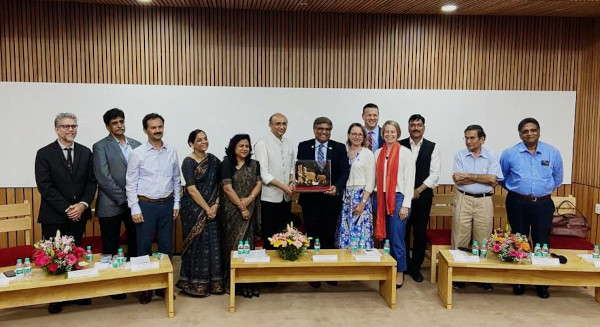
DBT and NSF Chiefs discuss biological manufacturing strategies at ABLE BIRAC joint meeting in Bengaluru
- by Narayanan Suresh - 31 Aug, 2023
ABLE in association with DBT-BIRAC organized a high-level Round Table with biotech industry leaders on August 23, 2023 in the presence of DBT (Department of Biotechnology) Secretary, Dr Rajesh S Gokhale and the visiting US National Science Foundation (NSF) Director, Dr Sethuraman Panchanathan. The meeting was held at the DBT-InStem facility in Bengaluru on August 23,2023. The key topic was to promote Indo-US collaborations in biotech innovation and biological manufacturing opportunities to reach the target of $ 100 billion biological manufacturing by 2030 from the current $ 40 billion level.
Industry leaders suggested attention to the following areas during their discussion with the top government policy makers.
- Scalable technologies to harness the power of tropical oceans to harness a wide range of industrial feed stock
- Invest in increasing the talent pool of human resources in handling development and manufacture of a variety of biosimilar therapeutics products. This is more important than funding or building infrastructure. Industry needs large number of talented scientists to scale up
- Simplified regulatory processes to encourage more biological manufacturing facilities
- Encourage local manufacturing of high end analytical and other instrumentation required by industry to reduce overall capex costs
- Use of more platform technologies to optimize manufacturing processes
- Collaboration between domestic players to leverage strengths
- Allow biological manufacturing investments to claim Productivity Linked Incentive (PLI) scheme benefits
- Tweak climate change policies to encourage large scale use of low carbon emission manufacturing processes using biomass
- Boost to manufacture of animal-free pharmaceutical ingredients that has huge global potential
- Tap demand for alternate milk proteins and other smart proteins by encouraging manufacture in the country to meet global demand
- PLI scheme should also incentivize manufacture of cell and gene therapy. Here large-scale volumes are not the criteria to be used
- Preferential buying of home-grown healthcare products in all sectors
- Circular economy sector has great potential and can feed the biomaterials needed in many industrial processes
- Low import duties on key raw materials needed to make high end oligonucleotides and other therapeutics for export markets
- A framework to encourage indigenous manufacture of fish meal and other ingredients in animal food sector using variety of insects
- Build infrastructure in the interface between incubators and large-scale manufacturing on the lines of Fraunhofer Institutes to provide affordable options for biotech startups to scale up into manufacturing
Earlier, inaugurating the round table, DBT Secretary, Dr Rajesh Gokhale outlined the efforts of BIRAC in the last 10+ years to catalyze the growth of the impressive innovation ecosystem in biotechnology. He thanked ABLE for being a partner in this endeavor. He said DBT has taken up the mission of increasing our country’s biological manufacturing industry and it will include efforts in synthetic biology, artificial intelligence and every other modern tools available.
Dr Gokhale forecast that the food processing industry will change dramatically with the alternative processes available and could be in the forefront of the biological manufacturing sector. And materials biology too will undergo transformation. He gave the example of how societies are now grappling with the huge amounts of discarded clothes and how to have a meaningful tackling of these products through the entire life cycle. Huge biotech opportunities exist in finding beneficial solutions to this mounting waste problem.
Dr Panchanathan outlined the structure and impact of research projects funded by the NSF in the US and in other countries. He emphasized that India is a valuable partner to NSF and the collaboration in research sector between the world’s two top democracies is gaining momentum due to the high level political leadership exchanges in recent years. NSF will collaborate with DBT to jointly fund many interesting research projects in biological manufacturing sector.
Earlier, Mr G S Krishnan, President, ABLE, welcomed the DBT Secretary and NSF Director and ABLE members. Dr Alka Sharma, senior advisor in DBT, briefed about the department’s efforts to foster cooperation with top countries. Dr Jitendra Kumar, managing director of BIRAC shared the company’s efforts to held the biotech innovation system. Dr P M Murali, President, ABLE Council of Presidents, moderated the discussions. Dr Dhananjay Tiwary, S&T Counsellor in Indian Embassy in Washington DC introduced the visiting NSF team. ABLE COO, Mr Narayanan Suresh, thanked DBT and the hosts In-Stem for the opportunity provided to the industry meet the government leaders and share their ideas to boost the country’s biological manufacturing segment.
The key topic was to promote Indo-US collaborations in biotech innovation and biological manufacturing opportunities to reach the target of $ 100 billion biological manufacturing by 2030 from the current $ 40 billion level.
voice for BT and BEST 2026