News
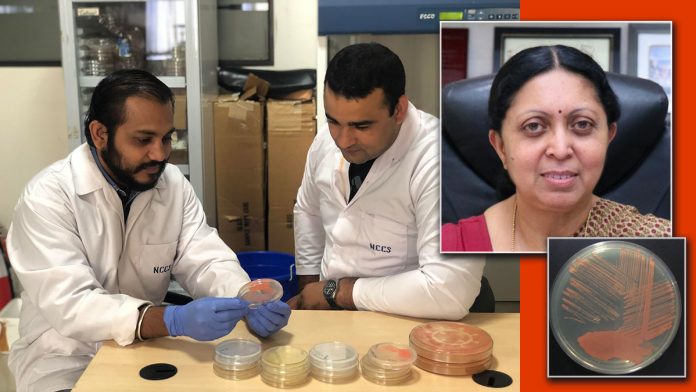
NCCS scientists discover new microorganism, name it after DBT Secretary Dr Renu Swarup
- by Team ABLE - 31 Jan, 2020
The organism belongs to a class of microorganisms called halophilic
archaeon, and it was isolated from Sambhar Lake in Rajasthan,
where it is known to form reddish-pink colonies.
It was discovered by a team of researchers from the National Centre
for Cell Science in Pune and NIIT University in Neemrana,
Rajasthan, who published their findings this week in the
International Journal of Systematic and Evolutionary
Microbiology.
The organism has been named Natrialba Swarupiae after Swarup,
who was appointed secretary in the Department of Biotechnology
(DBT) in 2018 after working there for nearly 29 years.
A PhD in genetics and plant breeding, she completed her post-
doctorate at The John Innes Centre, UK, on a Commonwealth
Scholarship. She returned to India in 1989 and joined the DBT as a
science manager.
The researchers said the decision to name the organism after
Swarup was meant to acknowledge “her support in microbial
diversity studies in India and also for the efforts taken to resolve the
NBA (National Biodiversity Authority) issues related to deposition
of microorganisms in repositories outside India”.
“She took major initiative in establishment of India’s largest
microbial repository named as National Centre for Microbial
Resource (NCMR, formerly Microbial Culture Collection or MCC)
with more than 2,00,000 culture holdings,” Avinash Sharma, one of
the researchers, told ThePrint in an email interview.
“The NCMR is providing quality services since 2012 to industry and
academia for research purpose,” added Sharma, a researcher at the
National Centre For Cell Science.
A strong trooper
India’s largest inland salt lake, Sambhar is an economically and
ecologically important site because of the visits of flamingos and
other migratory birds.
It is known to produce approximately 0.2 million tonnes of salt per
annum.
Archaea are one of the most primitive forms of life, known to
function in harsh environments like hot springs, glaciers or polar
regions, coal mines, high-salt ecosystems, and even high UV
exposure.
“Various studies on archaea… provide glimpse of life beyond Earth
because of their capabilities to grow in harsh conditions. Currently,
if you look at the understanding of archaea, especially their role,
they are poorly studied because they are very difficult to culture and
very few researchers are working in the area of cultivation of
archaea across the globe,” Sharma said.
Genomic sequencing of the isolated species revealed that it
belonged to a group that can survive extreme environmental niches,
especially waters saturated with salt.
The researchers found that these organisms grow at temperatures
between 35 and 50 degrees celsius, and can survive in water with up
to 35 per cent of salt content.
“The organism has unique DNA pathways that allow it to survive in
extremely saline conditions,” Sharma added.
SOURCE: https://theprint.in/science/resilient-new-microbe-named-after-modi-govt-secretary-whos-
easing-research-for-indians/354304/
New Delhi: NCCS Scientists have named a newly discovered single-cell organism that can survive in extreme environments after Dr Renu Swarup, secretary in the central government’s Department of Biotechnology.

voice for BT and BEST 2026