News
DBT posts Funding Opportunity Announcement (FOA)-2019 under Indo-US Collaborative Vision Research Program
- by Team ABLE - 19 Sep, 2019
The Department of Biotechnology & NEI-NIH have announced the Funding Opportunity titled India-U.S. Collaborative Vision Research Program Activity Code R01 Research Project Grant (for DBT).
This Funding Opportunity Announcement (FOA) encourages Multiple Principal Investigator (Multi-PD/PI) applications from United States (U.S.) and Indian institution as bilateral collaborations that will advance science and technology important to understanding, preventing, and treating blinding eye diseases, visual disorders, and their complications.
Areas of Research Collaboration: Applications are encouraged from organization/institutions that propose to conduct research on the basic biology and/or genetics of ophthalmic diseases through collaborations with Indian investigators on the following: diabetic retinopathy, glaucoma, age-related macular degeneration, retinitis pigmentosa, including rare and genetic diseases such as congenital cataracts, as well as other eye conditions such as ocular inflammation/uveitis, refractive error, low vision, and corneal injury. Basic, translational, or epidemiological research maybe proposed. Clinical trials will not be supported under this FOA.
Background: Scientific collaborations between India and the U.S. have been successfully conducted for several years under a variety of bilateral agreements. Recognizing that continuing collaborative research focused on eye diseases and visual disorders would be of mutual benefit to India and the U.S., the Indian Department of Biotechnology (DBT), the U.S. National Eye Institute (NEI), and a Joint Working Group (JWG) developed a strategic plan for collaborations and to facilitate the expedited review and clearance of proposed bilateral projects.
Both the DBT and the NEI have pledged funds to support joint activities pursued under this bilateral program. Several eye diseases such as diabetic retinopathy, Age-related Macular Degeneration (AMD), and glaucoma are complex and influenced by multiple genetic, epigenetic, and environmental factors including family, nutrition, and exposure to toxins. During the past decade progress has been made identifying these factors. In AMD, for example, environmental factors include smoking and sunlight have been shown to increase risk, and a diet rich in fatty acids has been shown to decrease risk. There are likely other unknown factors that are involved in precipitating AMD and other ocular diseases. Large scale genomic, proteomic, metabolomic, and informatic methods using emergent or current technologies to study unique populations are encouraged to identify new factors that can affect susceptibility to these diseases and/or ocular infections, as well as biomarkers that will provide the basis for accurate diagnostic test and predict treatment outcome.
There are also many eye conditions and complications such as inflammation that affect some intracommunity populations to a much greater extent, providing a valuable resource for learning more about visual restoration as well as the pathogenesis and physiology of a disorder. For instance, the impact of environmental pollutants, including those generated by cooking stoves, on the development of cataracts, as well as the susceptibility of toxins to cause infections, such as ocular TB and trachoma, are not well understood. Research on these populations that will further our understanding of neural plasticity including neurogenesis, cognition, and processing after treatment of visual disorders and injury are also of interest to the DBT and NEI. Research Objectives This FOA is intended to support collaborations between India and the U.S. that focus on the basic biology, epigenetic, and/or genetics of ophthalmic diseases and visual disorders.
Application Due Date(s) for submission to DBT November 09, 2019 by 5:00 pm local time.
For more details: http://dbtindia.gov.in/latest-announcement/funding-opportunity-announcement-foa-2019-under-indo-us-collaborative-vision
Applications are encouraged from organization/institutions that propose to conduct research on the basic biology and/or genetics of ophthalmic diseases.
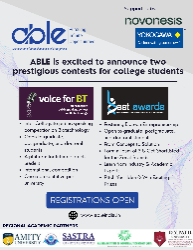
voice for BT and BEST 2026